
Key Takeaways
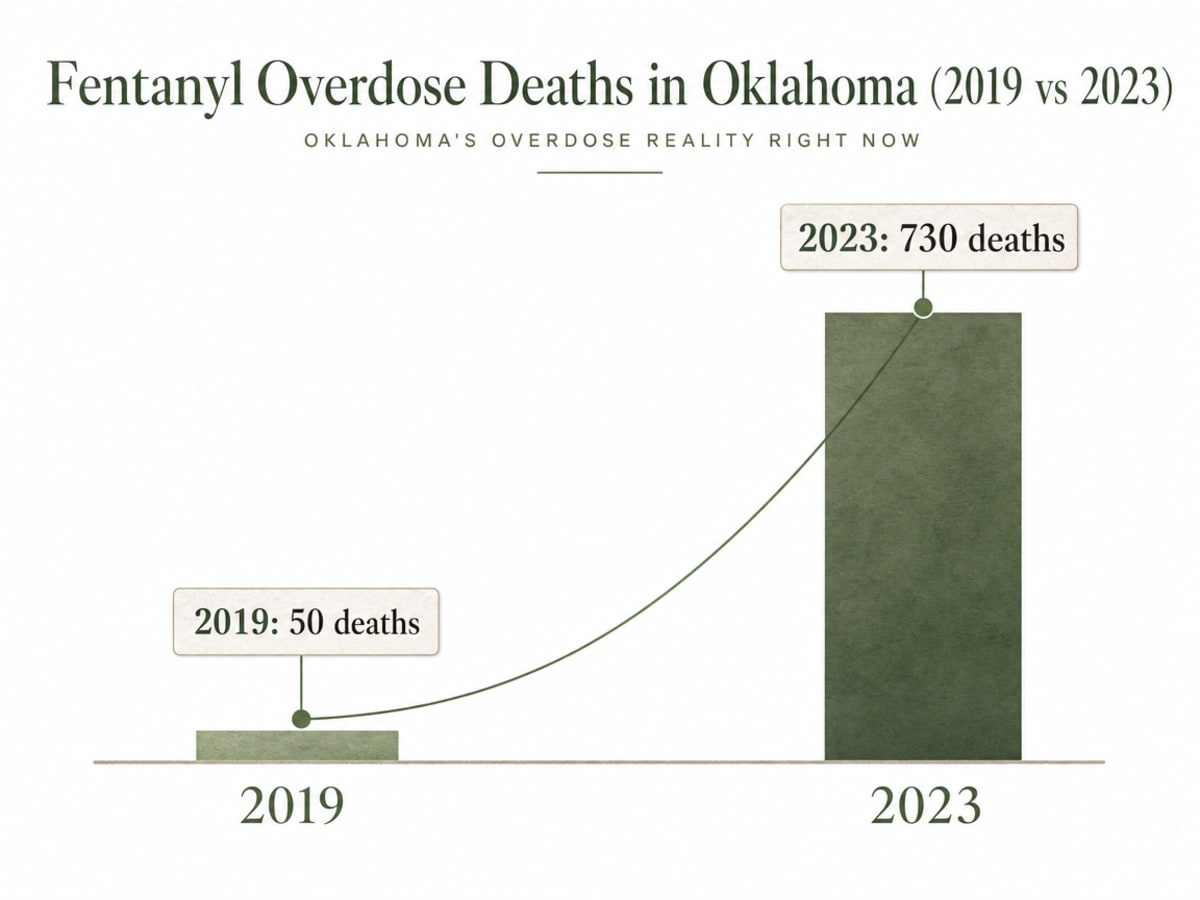
- Oklahoma’s fentanyl overdose deaths rose more than 14-fold between 2019 and 2023, making the gap between deciding to detox and actually getting into a bed genuinely urgent.4
- ODMHSAS certification is the state’s baseline for a legitimate medical detox, and its rules require a medical service plan within three hours of admission plus ongoing vital sign monitoring.1,2
- Comfort features like private rooms, quiet monitoring, gender-specific programming, and veteran tracks aren’t extras—they’re what keep people from walking out during the first 72 hours when withdrawal peaks.
- SoonerCare and most private insurers cover medically supervised detox with prior authorization handled by the facility, so a single call for free benefits verification is a reasonable next step.3,10
What “Comfortable” Actually Means When You’re in Withdrawal
If you’re reading this at 2 a.m. with your stomach turning and your hands shaking, the word “comfortable” probably sounds like a lie. Nothing about withdrawal feels comfortable. A comfortable detox facility Oklahoma can provide medical support when you need it most. That’s the honest starting point.
So let’s redefine the word. In a detox setting, comfort isn’t candles or thread counts. It’s whether you can sleep. It’s whether the nurse who checks on you at 3 a.m. speaks quietly and calls you by name. It’s whether the room is yours, not shared with a stranger going through their own crisis. It’s whether the medication that eases your symptoms shows up on time, every time, without you having to ask twice.
Comfort in detox is a clinical tool. When a person feels safe, they stay. When they stay, the medical team can finish the job of getting them through withdrawal and into whatever comes next. That’s why Oklahoma’s rules for medically supervised withdrawal management focus on things like timely medical planning, ongoing monitoring of vital signs, and written emergency procedures approved by a physician. Those rules set the floor. What happens above that floor, in the details of how you’re treated, is what makes a place feel like somewhere you can actually get better.1,2
Why the First 72 Hours Decide Everything
Oklahoma’s Overdose Reality Right Now
Here’s the part that’s hard to read, and important to say out loud: Oklahoma is not a safe place to wait.
Fentanyl overdose deaths in this state increased more than 14-fold in five years, from 50 deaths in 2019 to 730 deaths in 2023. That is not a slow trend line. That is a wall. And it means that if you or someone you love is using opioids, or using anything cut with them, the calendar between deciding to get help and actually getting into a bed matters more than it ever has.4
The overall drug overdose death rate in Oklahoma also climbed 44% when you compare the 2019–2023 stretch to the five years before it. So this isn’t only about fentanyl. It’s about a supply that has become more unpredictable across the board, and a body that, once it’s dependent, doesn’t get more forgiving with time.4
Why People Walk Out of Detox Before It’s Done
Getting through the door is one thing. Staying is another.
Most people who leave detox early don’t leave because they changed their mind about recovery. They leave because the room felt wrong. The lights were too bright. The bed was in a hallway. A staff member spoke to them like a chart, not a person. The nausea peaked at 4 a.m. and nobody came for twenty minutes. Somewhere in the middle of that, the part of the brain that’s been running the show for months whispers, “You can do this at home,” and the feet follow.
The first 72 hours are when the physical symptoms of opioid, alcohol, and benzo withdrawal usually peak. It’s also when your judgment is the least reliable it will be all month. If the environment around you is chaotic or cold, your nervous system reads that as one more reason to run. If the environment is quiet, private, and predictable — a nurse who checks on you before you have to ask, a door that closes, medication that arrives on schedule — your body has a chance to settle enough to let the medical team do its work.
That’s why comfort isn’t a bonus feature. It’s the thing that keeps you in the chair long enough to finish.
Inside a Comfort-Focused Detox Day
A Generic Clinical Detox vs. a Home-Like Setting
Picture two versions of the same Tuesday.
In the first, you wake up on a vinyl mattress under a fluorescent ceiling light that never fully turned off. A stranger in the next bed is coughing. Someone rolls a blood pressure cart down the hallway at 6 a.m. and asks you to put out your arm before you’ve opened both eyes. Breakfast is on a plastic tray. A television is bolted to a wall you can’t reach. The door doesn’t close. When you ask when your next dose is, the aide says, “I’ll check.”
In the second, you wake up in a room with a real bed, curtains, and a lamp you can turn off yourself. A nurse knocks before coming in. Vital signs still get taken — Oklahoma rules require ongoing monitoring of vital signs, food, and liquids in withdrawal management settings, along with a written emergency plan approved by a physician — but the cuff goes on quietly, the numbers get logged, and the nurse tells you what she just wrote down. Breakfast is warm. Your door closes when you want it to. The next dose has a time attached to it, and it arrives at that time.2
Both days meet the state’s clinical standard. Only one of them feels like a place you can stay for four more days.
That’s the whole point of a comfort-focused detox. The medicine is the same. The monitoring is the same. What changes is everything around it — the lighting, the noise, the tone of voice, whether the person taking your pulse also remembers that you have two kids at home. Those details are what your nervous system uses to decide, hour by hour, whether it’s safe to keep going.
Privacy, Dignity, and Not Feeling Like a Case Number
One of the quietest fears people bring to detox is not about withdrawal at all. It’s about being seen.
Seen by a coworker in the waiting room. Seen by a neighbor in the parking lot. Seen by staff who look at you the way people look at a problem instead of a person. If you’ve ever put off going to the doctor because you didn’t want to explain yourself, you already know how much that fear can cost.
A comfort-focused detox works hard on that. It looks like a private room instead of a shared bay. It looks like small admissions groups instead of a lobby full of strangers. It looks like a nurse who calls you by your first name because she asked which one you prefer. It looks like paperwork handled in a room with a door, not at a counter where three other people can hear your last name and your insurance card.
Dignity isn’t a slogan here. It’s whether you’re allowed to keep your own bathrobe. Whether you can shut a door when you cry. Whether the person changing your linens knocks first. Renewal Springs Detox in Oklahoma City is built around those specifics, because they’re what makes the difference between hiding from treatment and actually staying in it.
How Withdrawal Is Actually Managed (Medication and Monitoring)
Here’s what the clinical side of a good detox day looks like — the part that keeps you safe while the rest of the environment keeps you steady.
When you arrive, a licensed medical professional starts building your plan. Under Oklahoma’s rules, a medically supervised withdrawal management facility has to complete a medical service plan within three hours of admission. That’s not a formality. It’s the state saying, in writing, that you should not be sitting in a chair for six hours while people figure out what you need.1
From there, medication-assisted treatment does the heavy lifting on symptoms. For opioid withdrawal, that usually means buprenorphine or similar medications that calm the physical crash so your body isn’t screaming at you every ninety minutes. For alcohol and benzodiazepines, it means a tapered protocol that prevents seizures. For stimulants, it means sleep support, hydration, and treatment for the depressive plunge that follows heavy meth or cocaine use. The exact combination gets tailored to what you’ve been using, how long, how much, and what else is going on in your body.
Monitoring runs alongside all of it. Vital signs, food intake, fluids, and a written emergency procedure signed off by a physician are part of the baseline the state requires. At a facility like Renewal Springs, wearable technology from Huml Health tracks heart rate, sleep, and stress in real time, so a nurse can catch a rising pulse at 2 a.m. without shaking you awake to find it. The result is fewer intrusions, more accurate data, and a night where your body can actually rest.2
That combination — fast intake, the right medication, quiet monitoring — is how withdrawal stops being a fight and starts being a recovery.
What Oklahoma Actually Requires of a Detox Facility
ODMHSAS Certification Is the State License
When you’re looking at detox facilities in Oklahoma, one word does a lot of heavy lifting: certification. In this state, the Oklahoma Department of Mental Health and Substance Abuse Services (ODMHSAS) handles certification for substance-related treatment facilities, and that certification functions the same way a license does in other states. If a facility isn’t certified by ODMHSAS, it isn’t a legitimate medical detox. Full stop.7
What does certification actually mean for you? It means the facility has been inspected. It means their admission criteria, staffing, documentation, and quality assurance processes have been checked against Chapter 18 of the state’s rules for substance-related treatment services. Medically supervised withdrawal management in Oklahoma is tied to ASAM Level III.7-WM standards, which means physician-directed care with nurses on site.1,7
When you call any detox and ask if they’re ODMHSAS-certified, a good facility will answer without hesitation. Renewal Springs Detox in Oklahoma City operates under that certification, which is the baseline you should expect from anywhere you’d trust with your first 72 hours.
The Three-Hour Rule and Why Fast Intake Matters
Here’s a rule most people don’t know about, and it matters more than it sounds: in Oklahoma, a medically supervised withdrawal management facility has to complete your medical service plan within three hours of admission.1
Three hours. Not the same day. Not “when the doctor rounds tomorrow.” Three hours from the moment you walk through the door.
That rule exists because the state understands what you already feel in your body — withdrawal doesn’t pause for paperwork. When your pulse is climbing and your skin is crawling, waiting six hours in a lobby chair while someone chases down a physician isn’t just uncomfortable. It’s the moment a lot of people give up and walk out.
A comfort-focused facility treats that three-hour ceiling as a maximum, not a target. The goal is a licensed clinician sitting with you quickly, listening to what you’ve been using and for how long, and starting the medications and monitoring that actually make the next few days survivable.
Detox Isn’t Just for Opioids: Who Actually Shows Up
If you’re worried about fentanyl or heroin, you’re not wrong to be. But if you assume everyone in the next room is there for the same reason you are, the numbers say otherwise.
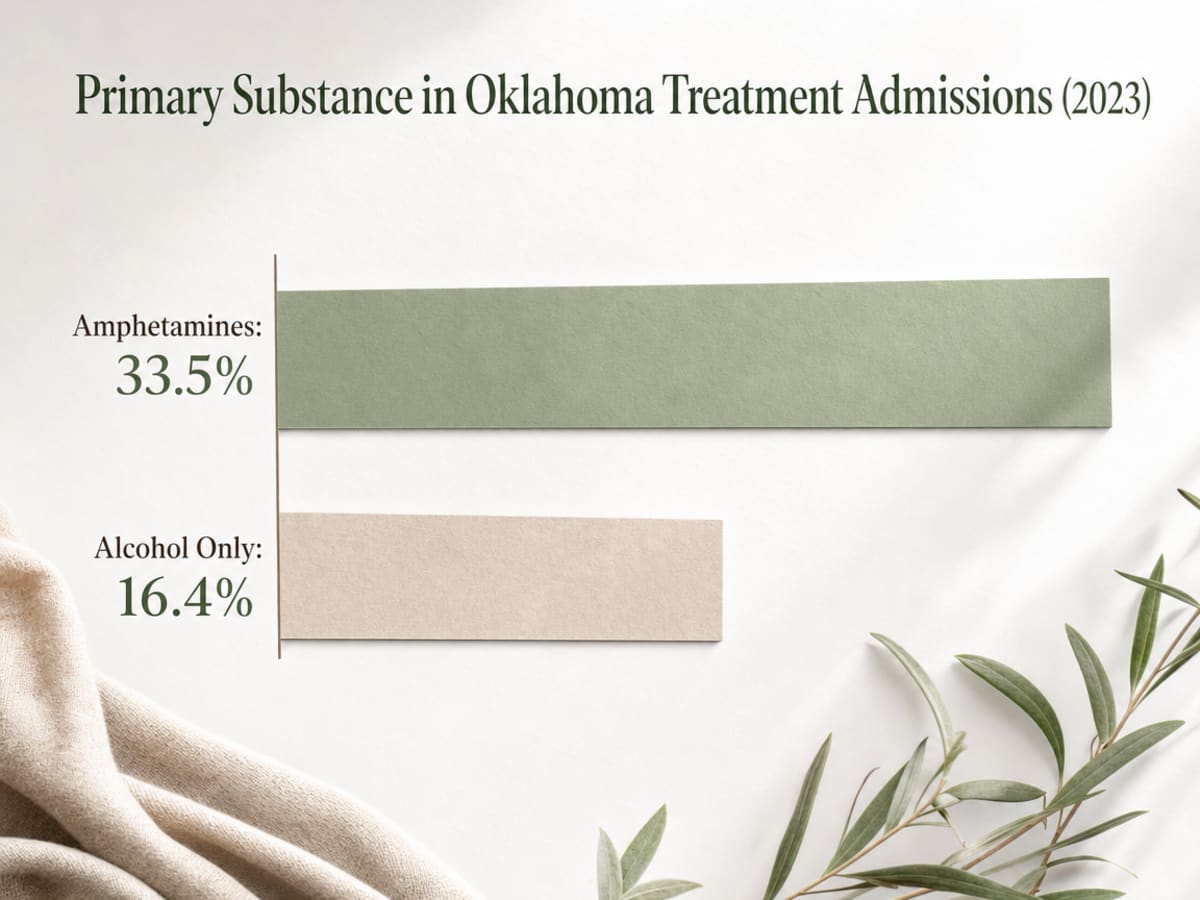
In 2023, Oklahoma recorded 14,559 substance use treatment admissions for people age 12 and up. The largest single group — 33.5% — came in with amphetamines as their primary substance, mostly methamphetamine. Alcohol as the sole primary substance made up another 16.4%. Opioids, cocaine, marijuana, benzodiazepines, and combinations of substances filled out the rest.6
That matters for you because it tells you what kind of staff and protocols a real Oklahoma detox has to handle every week. Opioid withdrawal needs buprenorphine and careful titration. Alcohol and benzodiazepine withdrawal needs a taper that prevents seizures — a genuinely dangerous complication if it’s mishandled. Meth and stimulant withdrawal looks different: crushing fatigue, a depressive drop that can turn suicidal, sleep that won’t come without help. Kratom brings its own opioid-like symptom pattern. Marijuana withdrawal, which people used to dismiss, produces real insomnia and irritability that can derail an early recovery.
A comfortable detox is a personalized one. The nurse asking what you’ve been using isn’t judging the list — she’s building the plan. If you tell her you’ve been mixing three things, she doesn’t blink. She adjusts. Renewal Springs Detox in Oklahoma City treats across the full range — alcohol, opioids, benzodiazepines, stimulants, kratom, marijuana, and combinations — because that’s what showing up in Oklahoma actually looks like.
Comfort for People Who Rarely Feel Safe in Medical Settings
Veterans, First Responders, and Trauma Histories
If you’ve worn a uniform — military, police, fire, EMS — a hospital-style detox can feel like the wrong kind of familiar. Bright lights. Locked doors. Someone asking you to describe the worst night of your life to a clipboard.
A comfort-focused detox works differently for you. Intake happens in a quiet room, not a hallway. Nobody presses for a full trauma history in the first hour — that comes later, with someone qualified to hear it. Doors are explained, not just locked. If a wearable monitor lets a nurse track your sleep and heart rate from the station down the hall, you get real rest instead of hourly wake-ups that pull you out of the only dream that didn’t turn bad. Renewal Springs runs a specific track for veterans in Oklahoma City because that population needs the room to feel like a room, not a barracks or a bay.
Men and Women: Why Environment Design Matters
Men and women often show up to detox carrying different weights. A man may be walking in with a decade of “handle it yourself” pressed into his shoulders, unable to say out loud how scared he is. A woman may be walking in with a history that includes someone who hurt her, and a very specific set of nerves about who has access to her room at night.
Gender-specific detox isn’t about separating people for its own sake. It’s about giving the group therapy conversations, the shared spaces, and the sleeping arrangements a shape that lets people actually talk. A woman-only wing means she can walk to the bathroom in a robe without scanning the hallway first. A men’s group means he can admit he’s been crying in his truck without performing anything. Both matter. Both are part of why Renewal Springs runs separate programs for men and women.
Families Watching From the Outside
If you’re the spouse, parent, sibling, or adult child reading this — we see you too. You’ve probably been the one making calls, checking bank accounts, listening for the front door at 3 a.m. That kind of watching wears a person down.
A comfort-focused detox thinks about you on purpose. It means a real person answers when you call, not a menu tree. It means someone tells you, within your loved one’s consent, that they arrived safely and are being cared for. It means the facility isn’t a black box you hand somebody to. You’re allowed to ask questions. You’re allowed to tour. You’re allowed to breathe.
Paying for Detox in Oklahoma Without a Cold Sales Call
Money is the reason a lot of Oklahomans put off calling. That’s fair. So here’s how the payment side actually works, without the hard sell.
Most private insurance plans cover medically supervised detox as a medical necessity, and SoonerCare (Oklahoma’s Medicaid) covers detox and residential substance use disorder services for eligible children and adults, with prior authorization required. Prior authorization sounds like a wall, but at a real detox facility, the staff handles that call for you. You should not be sitting in a lobby with your phone trying to explain diagnosis codes to an insurance rep while you’re in withdrawal.3
A good facility does free benefits verification before you commit to anything. You call, you give them your insurance card details, and someone calls you back with what your plan actually covers, what your out-of-pocket cost looks like, and whether there’s any gap. No signatures required to get that answer. Renewal Springs Detox works with most major insurance providers and handles verification at no charge, so you can find out what care costs before you have to decide anything.
If you’re uninsured or between plans, ask anyway. Ask about sliding-scale options, payment arrangements, or a referral through SAMHSA’s National Helpline, a free, confidential 24/7 service that can point you to covered options across the state. The worst answer you can get is a no. Most of the time, it isn’t.10
What Happens After Detox Ends
Detox isn’t the finish line. It’s the part that lets the rest of the race become possible.
After your body clears, the work shifts. The physical crisis is behind you, but the reasons you were using in the first place are still there — the trauma, the grief, the pain, the sleep problems, the relationships. That’s what residential and outpatient treatment are built to address, and Oklahoma’s system is designed as a continuum from crisis and detox into that next level of care.9
A good detox facility doesn’t hand you a discharge sheet and a bus schedule. Renewal Springs coordinates the handoff — residential programs, outpatient care, medication-assisted treatment continuation, sober living referrals — before you leave the building. You should know where you’re going and who’s expecting you.
That continuity is the difference between finishing detox and starting recovery. One without the other is a longer version of the same loop.
How to Take the Next Step Today
You’ve read this far, which already counts for something. The hardest part of getting into detox is almost never the paperwork or the drive. It’s the phone call.
So make it small. Call and ask one question. Ask what a private room looks like. Ask how insurance works. Ask what the first hour after you walk in feels like. You don’t have to commit to anything on that call. A comfortable detox facility should be willing to answer, tour you or a family member through the space, and let you decide from there.
If you’re in Oklahoma City, Renewal Springs Detox is a place you can call, visit, and see for yourself. If you’d rather start somewhere neutral, SAMHSA’s National Helpline runs a free, confidential, 24/7 referral line as well. Either way, today is a fine day to ask one question.10
Talk with someone who truly understands comfort
Get real answers about starting comfortable, medically supported detox right here in Oklahoma.
Frequently Asked Questions
Does SoonerCare or private insurance cover detox in Oklahoma?
Yes. SoonerCare covers detox and residential substance use disorder services for eligible children and adults, with prior authorization required. Most private plans also cover medically supervised detox as a medical necessity. A good facility handles the authorization call for you and verifies benefits at no charge before you commit to anything.3
How long does a typical detox stay last?
Most medically supervised detox stays run three to seven days, depending on what you’ve been using, how long, and how your body responds. Alcohol and benzodiazepine tapers sometimes run longer to prevent seizures. Opioid detox often stabilizes faster once medication-assisted treatment begins. Your medical team adjusts the length based on your daily symptoms.
What should I bring to a detox facility?
Keep it simple. Comfortable clothes for four to seven days, a robe, slip-on shoes, toiletries without alcohol in them, your ID, your insurance card, and a current list of medications. Leave valuables at home. Most facilities give you a list when you call. When in doubt, pack for a quiet stay, not a trip.
Can my family call or visit me during detox?
Yes, within limits you set. Once you sign a release, staff can confirm to your family that you arrived safely and share updates you approve. Phone contact is usually available after the first day or two, once symptoms ease. In-person visits vary by facility and by where you are in the process — ask when you call.
Will my employer or community find out I went to detox?
Not from the facility. Medical detox is protected by federal privacy laws that are stricter than standard HIPAA for substance use records. Nobody at the facility can confirm you’re a patient without your written consent — not your boss, not a family friend, not a neighbor who calls asking. Who knows about your care is your decision.
What happens if I need more help after detox is over?
That’s expected, not a failure. Oklahoma’s system is built as a continuum from crisis and detox into residential, outpatient, and medication-assisted treatment. Before you leave, staff should have a next step lined up — a residential bed, an outpatient intake date, or ongoing MAT. If you’d rather start neutral, SAMHSA’s National Helpline runs free 24/7 referrals.9,10
References
- Chapter 18. Standards and Criteria for Substance Related and Addictive Disorder Treatment Services (Effective September 15, 2021). https://oklahoma.gov/content/dam/ok/en/odmhsas/documents/policy/provider-certification/administrative-rules/2021/Chapter%2018%20Final%20effective%209-15-21.pdf
- Okla. Admin. Code § 450:24-3-64 – Ambulatory withdrawal management without extended on-site monitoring environment. https://www.law.cornell.edu/regulations/oklahoma/OAC-450-24-3-64
- Mental Health and Substance Abuse Services (SoonerCare Coverage). https://oklahoma.gov/ohca/individuals/programs/mental-health-and-substance-abuse-services.html
- Drug Overdose Deaths, 2019–2023 – Oklahoma (Fact Sheet). https://oklahoma.gov/content/dam/ok/en/health/health2/aem-documents/prevention-and-preparedness/injury-prevention/drug-overdose/2025%20State%20Drug%20OD%20-%20IPS%20-%20Fact%20Sheet.pdf
- Oklahoma – 2023 National Survey on Drug Use and Health (NSDUH State Tables). https://www.samhsa.gov/data/sites/default/files/reports/rpt56188/2023-nsduh-sae-state-tables_0/2023-nsduh-sae-state-tabs-oklahoma.pdf
- 2023 TEDS-A Oklahoma | CBHSQ Data. https://www.samhsa.gov/data/node/51076
- Oklahoma Summary – State Residential Treatment for Behavioral Health Conditions. https://aspe.hhs.gov/sites/default/files/2021-08/StateBHCond-Oklahoma.pdf
- 2023 Oklahoma State Report: Underage Drinking Prevention and Enforcement. https://library.samhsa.gov/sites/default/files/oklahoma-iccpud-state-report-2023.pdf
- Oklahoma Department of Mental Health and Substance Abuse Services – 2024/2025 State Plan (or similar planning document). https://digitalprairie.ok.gov/digital/collection/stgovpub/id/690834/
- SAMHSA’s National Helpline. https://www.samhsa.gov/find-help/national-helpline