
Key Takeaways
- Codeine dependence develops through normal biology, not weakness, and meets the clinical definition of opioid use disorder regardless of whether the drug came from a prescription, pharmacy shelf, or abroad.1,2
- Combination codeine products carry a second risk beyond dependence — escalating doses also push acetaminophen or ibuprofen intake into ranges that cause liver injury and gastrointestinal bleeding.9,1
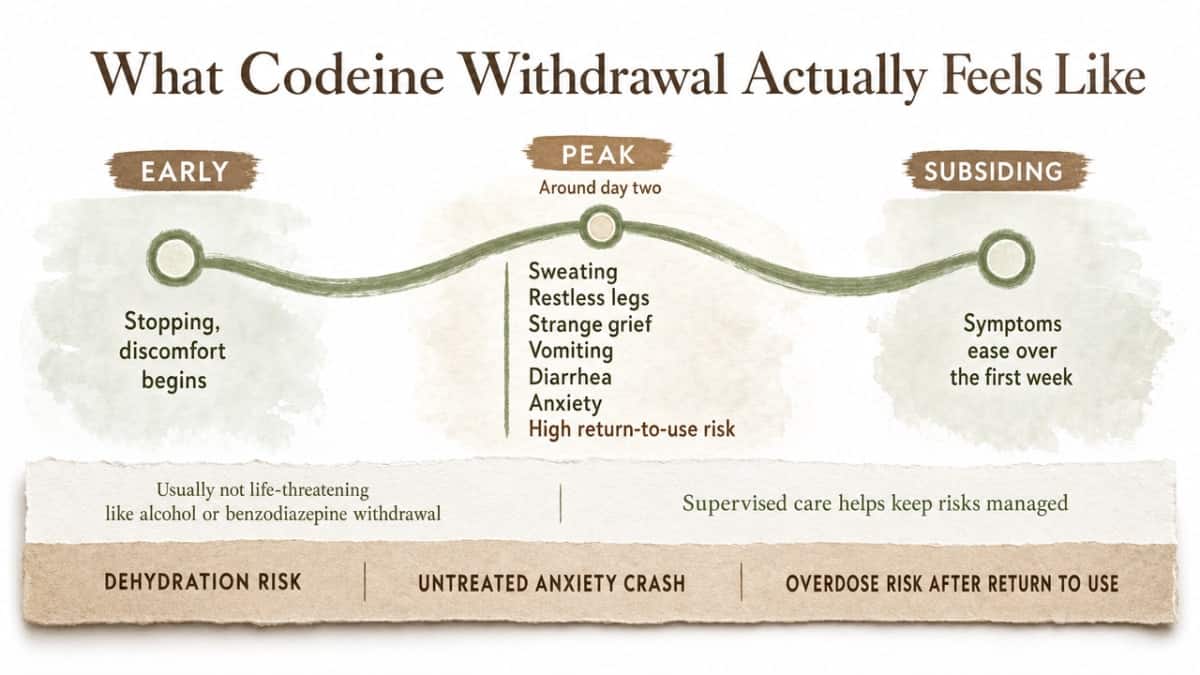
- Withdrawal typically starts within 8 to 24 hours, peaks between days two and four, and eases by day five to seven, with supervised care treating each phase to reduce dehydration, anxiety, and relapse risk.8
- Cold-turkey attempts usually fail because a dependent nervous system triggers an emergency-level response around hour 36; a supervised taper of roughly 15% per week or a switch to buprenorphine changes the physics.2,8
- Detox alone is not treatment — tolerance drops sharply after withdrawal, raising overdose risk, so the 2024 clinical guideline recommends moving directly into longer-term care.5,10
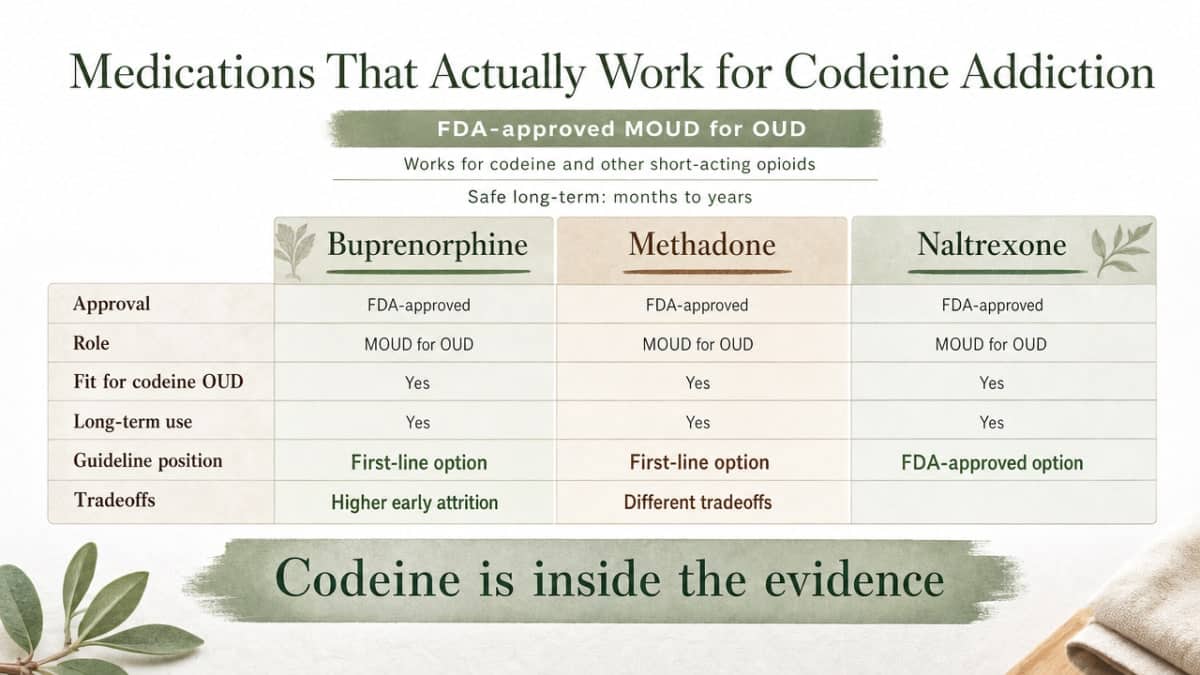
- The FDA approves buprenorphine, methadone, and naltrexone for opioid use disorder, and SAMHSA confirms these medications work for short-acting opioids like codeine and are safe for long-term use.4,10
- A first call to a provider is a brief intake about substances, doses, and medical history — not an interrogation — and SAMHSA’s free 24/7 helpline offers a no-commitment starting point.11,8
- Keeping naloxone accessible while deciding on treatment is a basic safety step for anyone with opioid exposure, prescribed or otherwise, and does not commit you to any decision about care.12
When a Cough Syrup Prescription Became Something Else
Maybe it started with a bottle of promethazine-codeine after a bad case of bronchitis. Perhaps it was Tylenol #3 after your wisdom teeth came out, or a box of combination codeine tablets a family member brought back from a trip abroad. The pain eased. The cough quieted. And somewhere along the way, the medicine stopped being about the original reason you took it, leading you to consider addiction treatment in Oklahoma.
If you’re reading this at 2 a.m., counting pills or ounces left in the bottle, you are not alone, and you are not weak. Codeine is an opioid. Your body responded to it the way human bodies respond to opioids: with tolerance first, then physical dependence, then a pull that feels much bigger than willpower. That progression is well documented in the clinical literature and is recognized as a form of opioid use disorder.2,1
You may be quietly wondering whether your use even “counts.” You got it from a pharmacist. A doctor wrote the script. It was legal. Here is the honest answer: how you started does not change what your nervous system is doing now. The people who study this call it OUD whether the opioid came from a prescription pad, a pharmacy shelf, or a street corner.1
This guide walks you through what treatment actually looks like — what withdrawal feels like, whether you need medical supervision, which medications work, and what happens when you make that first call. Take it one section at a time. You do not have to decide anything by the end of this page. Reading it is already a step.
Codeine Dependence and Opioid Use Disorder
One of the hardest parts of codeine dependence is that it often does not look like the version of “opioid addiction” you see on the news. There is no needle. There is no dealer. There might just be a familiar amber bottle in the medicine cabinet and a slow, private worry that has been growing for months. That does not disqualify you from care. It is exactly the situation clinicians see every week, and it fits squarely inside the diagnosis of opioid use disorder.1,2
The clinical definition is not about where the drug came from. It is about what your relationship with it has become: using more than you meant to, using longer than you meant to, needing more to get the same relief, feeling sick when you stop, and finding that the medication now shapes your day rather than the other way around. If several of those describe you, you meet the definition. That is not a character verdict. It is a medical description, and it points toward a real treatment path.2
How Codeine Use Can Lead to Dependence
Codeine is a short-acting opioid. Your brain notices that fairly quickly. The first week, the prescribed dose does what it was supposed to do. By the second or third refill, you might notice it wears off sooner. You take it a little earlier. Then a little more. Then you keep some in reserve, because being caught without it starts to feel scary.
Systematic reviews of over-the-counter and prescription codeine products describe this exact arc: legitimate use for pain, cough, or dental recovery, followed by escalation, then dependence, then difficulty stopping even when the original reason is long gone. Long-term users often develop physical dependence that makes abrupt discontinuation genuinely unsafe, which is why clinicians treat codeine like any other opioid when it comes to stopping.1,2
None of this required you to “abuse” the medication in the movie-villain sense. Your nervous system adapted the way opioid-exposed nervous systems adapt. You are not behind on some willpower quota. You are on a well-mapped biological path, and there is a well-mapped way off it.
Individual Differences in Codeine Metabolism
Maybe your sister took the same Tylenol #3 after her surgery and threw the leftovers out without a second thought. You took yours and felt something you wanted to feel again. That difference is not a moral one. A big piece of it is an enzyme called CYP2D6.
Codeine itself does not do much until your liver converts it into morphine, and that conversion is handled largely by CYP2D6. People carry different versions of this enzyme. Some are slow metabolizers, who barely feel codeine. Some are ultra-rapid metabolizers, whose bodies convert codeine to morphine much faster and more completely — which means a standard dose hits harder and dependence can build sooner.2
You did not choose your genes. You did not choose how your liver reads a pill. If your codeine story feels out of proportion to how much you actually took, this is part of why. It is also part of why the shame narrative — that you should have been able to handle it like everyone else — is simply wrong.
The Hidden Danger in Combination Codeine Products
If your codeine comes bundled with acetaminophen (as in Tylenol #3), ibuprofen, or a cough-and-cold formulation, there is a second clock running that most people never hear about. The opioid is doing one kind of damage to your brain. The other ingredients are doing a different kind of damage to your liver, stomach, and kidneys, and they do not care that you were following the label.
An Australian and New Zealand study of people harmed by over-the-counter codeine analgesics found that a substantial share of cases involved combination products, and the harms went well beyond opioid dependence. Patients presented with gastrointestinal bleeding and ulcers from the ibuprofen load, and hepatic injury from the paracetamol (acetaminophen) load, on top of the codeine dependence that had driven the escalation in the first place. The larger OTC medicines review echoes this pattern: codeine-containing analgesics rank among the most commonly misused non-prescription medicines, and serious gastrointestinal and liver complications are recurring themes in the literature.1,9
Here is why this matters for you specifically. When codeine tolerance builds, the dose creeps up. But you cannot raise the codeine without also raising every other ingredient in the tablet. Someone taking 24 combination tablets in a day to keep withdrawal at bay is also swallowing several times the safe daily ceiling of acetaminophen or ibuprofen. The liver and stomach lining were not consulted.
You may already be noticing signs — a dull ache under your right ribs, dark stools, heartburn that never quite leaves, unexplained bruising, fatigue that sleep does not fix. None of this makes you a lost cause. It makes the timeline more urgent, not less hopeful. A medically supervised intake will check liver enzymes, kidney function, and a basic blood count before anything else, because knowing what the combination has been doing changes how detox is run and how quickly follow-up care needs to happen.
If you have been using combination products for months, please do not wait for a scarier symptom to give yourself permission to ask for help. The codeine story and the organ-damage story are the same story, and both get better once someone qualified is actually looking at the whole picture.
What Codeine Withdrawal Actually Feels Like
The fear of withdrawal is often what keeps people using longer than they meant to. You may have already tried to stop once or twice and hit a wall around day two — the sweating, the restless legs, the strange grief that shows up out of nowhere — and decided the medication was the lesser evil. That decision made sense with the information you had.
Here is what is worth knowing before you try again. Codeine withdrawal is genuinely uncomfortable, but for most people it is not life-threatening the way alcohol or benzodiazepine withdrawal can be. What makes it dangerous is not the symptoms themselves — it is dehydration from vomiting and diarrhea, the crash of untreated anxiety, and the very high risk of returning to use at a dose your body no longer tolerates. That last piece is where overdose deaths happen. A supervised setting exists to keep all three of those risks small.8
The Timeline: Early, Peak, and Subsiding Symptoms
Codeine is short-acting, so early withdrawal usually starts within 8 to 24 hours of your last dose. The first signs are the ones that feel most like a bad flu: yawning that will not stop, watery eyes, runny nose, sweating, goosebumps, muscle aches, and a low, humming anxiety. You may feel cold and hot in the same hour.
Peak symptoms tend to arrive between days two and four. This is the stretch people describe as the worst — stomach cramps, nausea, vomiting, diarrhea, insomnia even when you are exhausted, restless legs that refuse to settle, and a heavy, hopeless mood that can feel bigger than the physical symptoms combined. Cravings are loudest here.
Somewhere around day five to seven, the acute physical symptoms start to fade. Sleep improves in pieces. Appetite returns. What often lingers longer is the emotional weather — low mood, low energy, and cravings that can flare weeks after the last dose. In supervised care, each phase gets specific attention: fluids and anti-nausea medication for the gut, non-opioid options for muscle pain and anxiety, and, where appropriate, opioid agonist medication to smooth the whole curve.8
Why Cold-Turkey Rarely Works, and What a Supervised Taper Looks Like
You may have already run the cold-turkey experiment on yourself. Most people with codeine dependence have. It fails for reasons that are not about willpower. Around hour 36, your brain sends a signal that is functionally indistinguishable from an emergency, and the closest thing to a fire extinguisher is the medication you just stopped taking. Restarting at that moment is not weakness. It is exactly what a dependent nervous system is wired to do.
A supervised taper changes the physics of the problem. Instead of asking you to endure the full withdrawal curve on your own, a clinician sets a schedule your body can actually follow — that 15%-per-week reduction, or a switch onto a longer-acting medication like buprenorphine that keeps receptors calm without the peaks and troughs of short-acting codeine. Vital signs get checked. Sleep gets addressed. Nausea gets treated before it becomes dehydration. If a step down turns out to be too steep, the plan gets adjusted rather than abandoned.2,8
The other thing a supervised setting quietly does is remove the daily decision. You do not have to argue with yourself at 6 a.m. about whether today is the day. Someone else is holding the schedule, and your only job is to get through the hours in front of you.
Detox Is the Start, Not the Treatment
Here is the sentence most people never hear until they are already in the middle of it: getting through withdrawal is not the same as being treated. Detox clears codeine from your system and stabilizes your body. That matters. It is also, on its own, one of the most dangerous moments in the whole process — because a body that has just finished a taper has lost its tolerance, and a return to a previous dose can cause an overdose that would not have happened three weeks earlier.
The 2024 national clinical practice guideline on opioid use disorder is direct about this: withdrawal management by itself does not treat OUD, and people who complete detox without moving into longer-term care face high rates of return to use and elevated overdose risk in the weeks after. SAMHSA frames the same point from the other direction — medications for opioid use disorder are effective specifically for short-acting opioids like codeine, and they are safe for long-term use, from months to years, depending on what your life needs.5,10
What this means for you is practical, not philosophical. If you are picturing a week of hard days followed by a handshake and a discharge paper, please picture something else. A good program treats detox as day one of a longer arc: withdrawal stabilization, then a conversation about medication, then a warm handoff into outpatient care, counseling, or a residential step if that fits your life. You do not have to plan the whole arc tonight. You only have to know that a real path does not end when the shaking stops.
Medications That Actually Work for Codeine Addiction
Once your body is stable, the next question is what keeps you stable — for months, not just for a weekend. The FDA has approved three medications for opioid use disorder: buprenorphine, methadone, and naltrexone. SAMHSA is specific that these work for OUD tied to short-acting opioids like codeine, and that they are safe to use long-term, from months to years, depending on your life.4,10
Read that again if it helps. The medications built for opioid use disorder were built for exactly what you have. Codeine is not a special case that falls outside the evidence. It is inside it.
The 2024 national clinical practice guideline update names buprenorphine and methadone as standard first-line options for opioid agonist therapy, with honest tradeoffs between them: buprenorphine tends to have higher early attrition (some people drop out in the first weeks), while methadone carries greater early mortality risk during the induction period. Neither is a slam dunk. Both are backed by decades of outcome data showing lower relapse, lower overdose, and better retention in care compared to detox alone. Naltrexone rounds out the three as a non-opioid option for people who have already cleared withdrawal and want to block the effects of any future use.5
What follows is a plain look at each one. You do not have to pick before you call. This is what a prescriber will walk through with you.
Buprenorphine
Buprenorphine is a partial opioid agonist. It sits on the same brain receptors codeine has been reaching for, but it does not produce the same high, and its effect has a built-in ceiling that makes overdose harder. Practically, that means the receptors go quiet. The gnawing background hum of “when is the next dose” fades into something you can think around.
It is often prescribed in an office setting rather than a specialty clinic, which lowers the day-to-day friction of staying on it. The 2024 guideline flags one honest catch: some people struggle in the first weeks and drop out before the medication has a fair chance to work. Sticking with induction, and asking for a dose adjustment when something feels off, is where a good prescriber earns their keep.5
Methadone
Methadone is a full opioid agonist, and it has the longest track record of any OUD medication in the world. It is long-acting, so one daily dose keeps receptors steady for 24 hours, which stops the peak-and-crash cycle that made codeine so hard to put down. For people with heavier or longer-term dependence, that steadiness can be the difference between white-knuckling and actually living.
In the U.S., methadone for OUD is dispensed through federally certified opioid treatment programs. That means going to a clinic, at least at first. The 2024 guideline is candid that early mortality risk is higher during methadone induction than with buprenorphine, which is why the first weeks are dosed carefully and monitored.5,6
Naltrexone
Naltrexone is the odd one out — it is not an opioid at all. It blocks opioid receptors, so if you took codeine while on it, the codeine would not do much. It comes as a daily pill or, more commonly for OUD, a monthly injection.
The catch is timing. You have to be fully through withdrawal before starting naltrexone, or the medication will slam the door on receptors that still have opioid attached and cause severe precipitated withdrawal. For someone who has completed detox and wants an option with no opioid agonist activity at all, it is a real tool.10
Addressing the “Swapping One Drug for Another” Question
You have probably heard this one, maybe said it to yourself. It is worth answering directly, because the shame of it keeps people out of care that would help them.
Buprenorphine and methadone are opioids. That part is true. What they are not is codeine. They are long-acting, steady-state medications taken on a schedule that a clinician sets, not a craving. They do not produce the roller coaster of a short-acting opioid. They let you go to work, drive your kids, sleep through the night, and forget about the medication cabinet for hours at a time. The FDA and SAMHSA classify them as treatment, not substitution, because the outcomes — fewer overdoses, fewer returns to use, and longer lives — are what a treatment is supposed to deliver. Insulin is not a moral failure for a diabetic. Neither is this.4,10
What Happens on Your First Phone Call
You have probably rehearsed this call in your head a dozen times. Maybe you have picked up the phone and put it back down. Maybe you have gotten as far as dialing and hung up before it rang through. That is not failure. That is what it looks like to be a human being trying to say something out loud that has been living quietly in your chest for months.
Here is what the call actually is, so the imagined version stops being scarier than the real one. Somebody answers. That person is trained to talk with people in exactly your situation, and they have heard every version of the codeine story — the cough syrup that never got thrown out, the dental script that lasted longer than the pain, the pharmacy trip abroad that turned into a habit. You do not have to have your words ready. You can start with, “I think I need help and I don’t really know how this works.” That is a full and complete opening sentence.
If you would rather not call at all yet, SAMHSA runs a free, confidential, 24/7 helpline that handles referrals and information for substance use concerns anywhere in the U.S. — no insurance question up front, no name required, no commitment to anything after you hang up. Some people use it as a first, no-stakes practice round before calling a local program. That is a legitimate way to use it.11
What They’ll Ask, and What You Don’t Have to Explain
Expect a handful of questions, not an interrogation:
- What are you taking, roughly how much, and for how long.
- When was your last dose.
- Are you using anything else — alcohol, benzos, sleep aids.
- Any medical conditions, current medications, or past withdrawal experiences they should know about.
- Whether you have insurance, though most intake teams will verify benefits for you rather than making you decode your own plan.
What you do not have to bring: a tidy origin story, a diagnosis, a number of pills you feel proud of, or an explanation for why you did not call sooner. Nobody on the other end is grading you. They are gathering the information a clinician needs to keep you safe during the first 72 hours, which is the whole point of the conversation.8
Naloxone and Safety While You’re Deciding
You might not call today. You might read this, close the tab, and think about it for a week. That is okay. One thing worth doing in the meantime, though: get naloxone in the house.
Naloxone is the medication that reverses an opioid overdose, and codeine is an opioid. SAMHSA urges people with any opioid exposure — prescribed, OTC, or otherwise — to have it on hand and to make sure someone else in the home knows where it is and how to use it. Most Oklahoma pharmacies carry it without a prescription, and many county health departments distribute it free. This is not a signal that you have decided anything about treatment. It is a seatbelt for the drive between now and whenever you are ready.12
A Small Next Step From Wherever You Are Right Now
You do not have to decide about treatment tonight. You do not have to know which medication you want, or how many days off work you can take, or how to tell your family. Those questions belong to a future version of you who has more information than you have right now.
What this version of you can do is one small thing:
- Save a number in your phone under a name only you will recognize.
- Pour out the pills you have been keeping in reserve, or hand the bottle to someone you trust.
- Text a friend the words “I’m working on something and I might need you soon” — no explanation required.
- Bookmark this page and come back to it in the morning when the light is different.
When you are ready for the next step, medically supervised detox is designed for exactly what you are describing — a body that has become physically dependent on codeine and needs a safe, monitored way through withdrawal before longer-term care begins. In Oklahoma, Renewal Springs Detox is one option among several, and any licensed program with 24/7 medical supervision can meet you where you are.5,10
You have already done the hardest part — you named it. Everything after this is just logistics.
Speak Directly With a Supportive Detox Professional
Get immediate answers and support for your next step in codeine withdrawal recovery.
Frequently Asked Questions
Is codeine really addictive if I only got it from a prescription or the pharmacy?
Yes. How you got the medication does not change what your body does with it. Codeine is an opioid, and opioids cause tolerance and physical dependence whether they come from a prescription pad, a pharmacy shelf, or anywhere else. Clinicians describe this as opioid use disorder based on your current relationship with the drug, not on how it started. A legal beginning does not disqualify you from real treatment.1,2
Do I need medical detox, or can I just stop taking codeine on my own?
If you have been taking codeine daily for weeks or longer, stopping abruptly is not recommended. Withdrawal is rarely life-threatening by itself, but dehydration, untreated anxiety, and a return to a previous dose after tolerance drops can be dangerous. A supervised setting manages symptoms with fluids, non-opioid medications, and, when appropriate, a slow taper or MOUD. You do not have to earn your way in by trying cold-turkey first.2,8
Isn’t taking buprenorphine or methadone just swapping one drug for another?
No. Buprenorphine and methadone are opioids, but they are long-acting, steady-state medications taken on a clinical schedule — not to chase a feeling. The FDA approves them for opioid use disorder because outcomes get better: fewer overdoses, fewer returns to use, and longer lives. SAMHSA specifically notes they are effective for short-acting opioids like codeine and safe for long-term use, from months to years. Treatment is not the same as substitution.4,10
How long does codeine withdrawal last?
Codeine is short-acting, so early symptoms usually start within 8 to 24 hours of your last dose. Peak discomfort — cramps, nausea, insomnia, restless legs, low mood — tends to fall between days two and four. Acute physical symptoms typically ease by day five to seven, though low energy and cravings can linger for weeks. Supervised care shortens the worst of it by treating each phase directly.8
What happens when I call a treatment provider for the first time?
Someone trained answers. They ask what you are taking, how much, how long, when your last dose was, and whether other substances or medical conditions are in the picture. They usually verify insurance for you. You do not need a tidy story or a diagnosis. If a direct call feels like too much, SAMHSA’s free, confidential 24/7 helpline can walk you through options first with no commitment. Starting somewhere is the point.11
Should I have naloxone on hand while I’m still using codeine or deciding what to do?
Yes. Codeine is an opioid, and naloxone reverses opioid overdose. SAMHSA recommends that anyone with opioid exposure — prescribed, OTC, or otherwise — keep naloxone accessible and make sure someone in the home knows how to use it. Most Oklahoma pharmacies stock it without a prescription. Having it does not commit you to a decision about treatment. It is a safety net while you figure out the next step.12.
References
- A mixed-methods systematic review of the prevalence, reasons, associated harms and risk-reduction interventions of over-the-counter (OTC) medicines misuse, abuse and dependence in adults. https://www.ncbi.nlm.nih.gov/pmc/articles/PMC8439034/
- Codeine – StatPearls – NCBI Bookshelf. https://www.ncbi.nlm.nih.gov/books/NBK526029/
- Introduction to Medications for Opioid Use Disorder Treatment. https://www.ncbi.nlm.nih.gov/books/NBK574914/
- Information about Medications for Opioid Use Disorder (MOUD). https://www.fda.gov/drugs/food-and-drug-administration-overdose-prevention-framework/information-about-medications-opioid-use-disorder-moud
- Management of opioid use disorder: 2024 update to the national clinical practice guideline. https://pmc.ncbi.nlm.nih.gov/articles/PMC11573384/
- Federal Guidelines for Opioid Treatment Programs. https://www.med.unc.edu/fammed/nctac/wp-content/uploads/sites/1256/2025/01/federal-guidelines-opioid-treatment-pep24-02-011-1.pdf
- CDC Clinical Practice Guideline for Prescribing Opioids. https://www.cdc.gov/opioids/providers/prescribing/guideline.html
- Withdrawal Management. https://www.ncbi.nlm.nih.gov/books/NBK310652/
- Over-the-counter codeine analgesic misuse and harm: characteristics of cases in Australia and New Zealand. https://pubmed.ncbi.nlm.nih.gov/22143850/
- Treatment Options for Substance Use Disorder. https://www.samhsa.gov/substance-use/treatment/options
- National Helpline for Mental Health, Drug, Alcohol Issues. https://www.samhsa.gov/find-help/helplines/national-helpline
- Opioid Overdose Reversal Medications (OORM). https://www.samhsa.gov/substance-use/treatment/overdose-prevention/opioid-overdose-reversal
- Key Substance Use and Mental Health Indicators in the United States. https://www.samhsa.gov/data/sites/default/files/NSDUH-FFR1-2016/NSDUH-FFR1-2016.htm